
When Rockstar Games revealed the first look into the sun-soaked state of Leonida and the neon-lit streets of Vice City, the gaming world stood still. While players were eager to dissect the storyline of dual protagonists Jason and Lucia, tech-savvy fans and gamers quickly noticed something else: the jaw-dropping graphical leap.
Powered by the upgraded RAGE 9 engine, Grand Theft Auto VI isn't just scaling up resolution—it’s rethinking how open-world physics, lighting, and environments interact. From dynamic hair simulation to ultra-realistic water physics, here are 10 incredible graphic and realism details in GTA 6 that fans cannot wait to explore.
Strand-Based Hair Physics and Dynamic Styling
In previous open-world games, character hair was often treated as a solid block or a collection of stiff meshes. GTA 6 completely overhauls this by introducing strand-by-strand hair physics for both main characters and background NPCs.
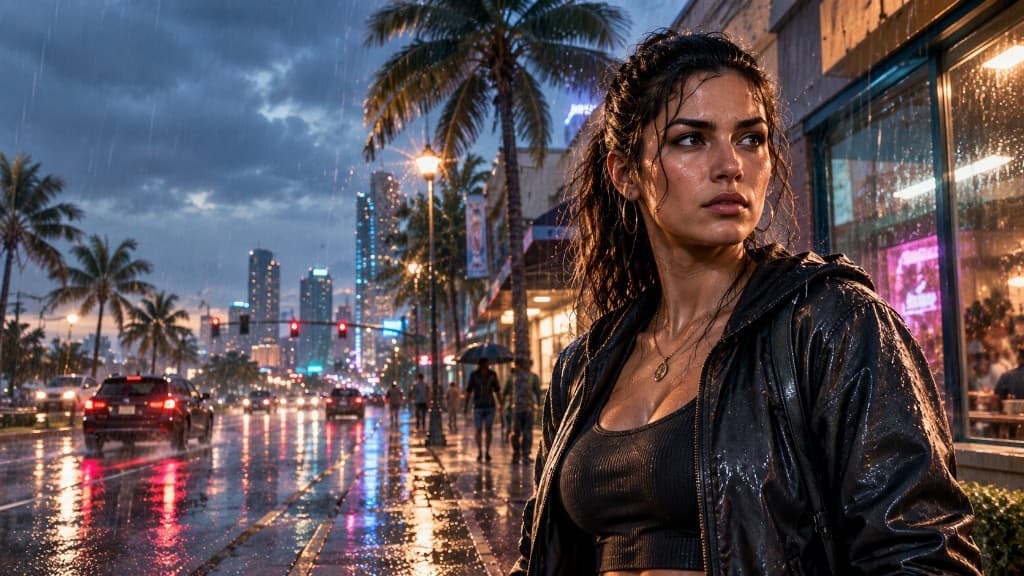
Whether Lucia is riding a speedboat with her hair whipping in the ocean breeze or Jason is walking through a muggy Miami-esque downpour, strands react dynamically to wind, moisture, and motion. Fans are thrilled to see how haircuts, hair accessories, and natural elements alter a character's appearance in real-time.
Next-Level Water Simulation and Ocean Physics
Set in a fictionalized version of Florida, water plays a massive role in Leonida. Rockstar has reportedly built a dedicated fluid simulation pipeline for GTA 6.
Waves don't just follow a set animation loop; they dynamically react to:
- Boat hulls pushing through wake
- Weather conditions like incoming hurricanes or tropical storms
- Shallow beach tides washing over realistic, shifting sand geometries
Real-Time Hardware-Accelerated Ray-Tracing
While GTA V relied heavily on baked lighting and screen-space reflections, GTA VI harnesses hybrid ray tracing and dynamic global illumination.
Neon signs in Vice City reflect accurately off wet asphalt, car windows distort passing traffic realistically, and sunlight filters through swamp haze with natural volumetric light shafts (crepuscular rays). The ambient lighting transforms depending on humidity, fog, and the time of day, delivering unprecedented photorealism.
Unprecedented NPC Density and Diversity
One of the biggest complaints in open-world titles is seeing the same "cloned" pedestrian walking around every corner. GTA 6 tackles this with unprecedented NPC crowd density and custom procedural designs.
Ocean Drive is packed with hundreds of unique pedestrians carrying out independent routines—sunbathers applying lotion, beachgoers filming live videos on smartphones, and joggers reacting to ambient sounds. Analysts note that even minor NPCs feature custom clothing physics, unique body shapes, and varied skin tones.
Subsurface Scattering on Human Skin
Making digital characters look human without crossing into the "uncanny valley" is one of graphics design's toughest challenges. In GTA 6, Rockstar utilizes advanced subsurface scattering shaders.
This technology simulates how light penetrates human skin and bounces underneath the surface. As a result, ears glow slightly translucent when backlit by the sunset, skin flushes realistically in heat or stress, and sweat reflects ambient neon lights in nightlife scenes.
Procedural Vehicle Deformation and Damage Models
Driving mechanics and crashes are central to the Grand Theft Auto experience. GTA 6 raises the bar by overhauling its vehicle deformation engine.
Instead of pre-scripted dent animations, car crashes now result in procedural metal bending, crumple zones, and paint abrasion. Scratches reveal underlying primer coats, side mirrors snap off dynamically based on impact angle, and high-speed wrecks leave realistic debris fields on the roadway.
Dynamic Volumetric Clouds and Micro-Weather Systems
Florida weather is notorious for turning from sunny to a torrential cloudburst within minutes—and GTA 6 captures this perfectly. The game introduces fully 3D volumetric cloud layers that drift across the sky, casting real-time shadows onto the terrain below.
Rather than changing the entire map's climate at once, rain and heat haze can exist as localized micro-weather systems. You might see a storm brewing over the Keys while Vice City's downtown remains drenched in golden-hour sunlight.
Interactive Interior Geometry and Destruction
Unlike older games where most buildings felt like empty, static blocks, GTA 6 expands interior access. Many storefronts, gas stations, clubs, and residential spaces are fully rendered without loading screens.
Even more impressive is the level of interactive micro-detail. Bullet hits shatter glass realistically based on point of contact, interior light fixtures sway during firefights, and loose items on shelves react to physical collisions.
Advanced Physically-Based Rendering (PBR) Materials
Every texture in GTA 6—from dusty pickup truck hoods to polished marble hotel lobbies—uses modern Physically-Based Rendering (PBR).
This means materials react strictly to real-world physics:
- Leather jackets reflect light differently than cotton shirts.
- Wet concrete retains dark water patches that dry gradually over time as the sun comes out.
- Vehicle paint coatings feature distinct clear-coat layers that catch light independently from the metallic base layer underneath.
Hyper-Detailed Muscle and Body Movement Animations
Realism isn't just about static imagery; it's about how things move. GTA 6 integrates muscle deformation and weight physics into character locomotion.
When a character sprint-cuts a corner, carries heavy duffel bags, or vaulting over barriers, you can physically see weight distribution change, muscles tense under skin, and clothing fabric stretch accurately around joints.
Final Thoughts
Grand Theft Auto VI is poised to set a new benchmark for open-world gaming. Through revolutionary physics, next-gen lighting, and hyper-realistic world details, Rockstar Games isn't just updating graphics—they're building a living, dynamic world. As fans eagerly wait to explore Vice City, one thing is clear: GTA 6 will redefine technical brilliance and immersion for years to come.