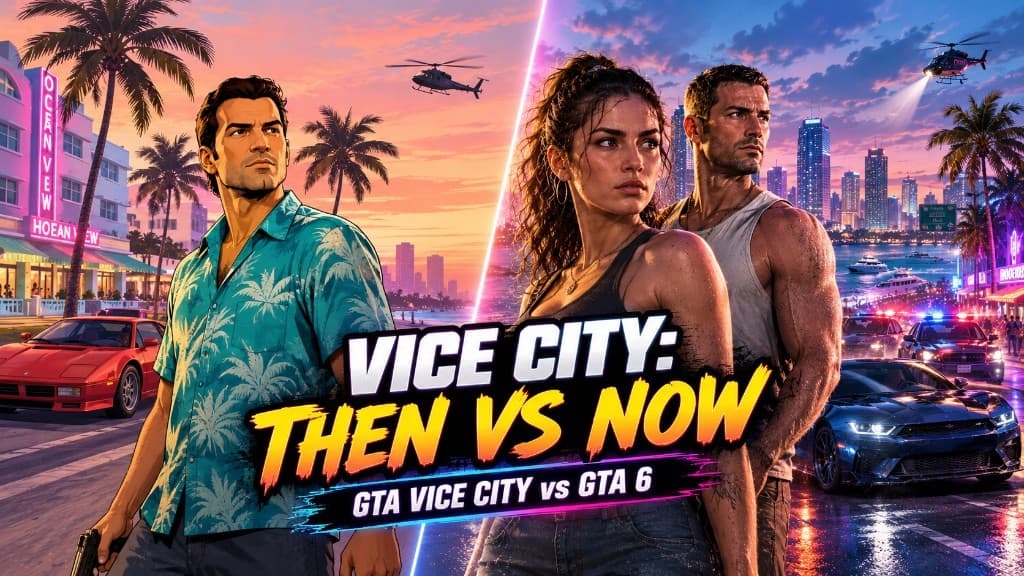
When Rockstar Games released Grand Theft Auto: Vice City in 2002, it instantly became an iconic gaming experience. Players fell in love with its pastel suits, synth-wave radio stations, neon-lit strip, and 1980s Scarface aesthetics.
Now, with Grand Theft Auto VI, players are finally returning to the fan-favorite, Miami-inspired metropolis. However, this isn't just a simple graphical remaster. Rockstar has completely reimagined the location from the ground up.
So, what makes GTA 6’s Vice City different from the original GTA Vice City? From massive shifts in scale to modern-day cultural satire, here is everything that sets these two generations of Vice City apart.
Scale and Environment: A Single City vs. The State of Leonida
Rockstar Games has dramatically reimagined the open-world layout for its return to Vice City. While the iconic metropolis serves as the vibrant urban centerpiece, it no longer makes up the entire map. Instead, Vice City is now just one part of the expansive State of Leonida. This shift introduces massive ecological diversity, taking players far beyond paved streets into sprawling swamps, coastal keys, rural highways, and dense wilderness.
The Original (2002)
The 2002 classic offered a compact, tightly designed playground suited for its era. Focused strictly on Vice City proper, the map was split into two primary landmasses—Beach and Mainland—connected by a series of bridges. Though small by today's open-world standards, its dense grid, vibrant neon strips, and iconic 1980s atmosphere made every street corner memorable for players.
GTA 6 (2026)
The modern iteration completely expands the franchise's horizons by integrating Vice City into a vast, seamless ecosystem. Players can seamlessly transition from bustling downtown skyscrapers to murky, alligator-infested wetlands and tropical island chains. Enhanced rendering, realistic weather effects, and immense regional scale make this version of Leonida feel like a truly living, breathing digital world rather than just a city.
Instead of being confined to city streets and beaches, players in GTA 6 can explore the sprawling rural regions beyond the city limits. This includes the Grassrivers (a take on the Florida Everglades), the archipelago of the Kelly Keys, murky swamps, and surrounding smaller towns. Map comparisons estimate the overall world of GTA 6 to be multiple times larger than the original map.
| Feature | GTA: Vice City (2002) | GTA 6 | | --- | --- | --- | | Setting Scope | Metro Vice City Only | Vice City & State of Leonida | | Map Structure | Two main urban islands | Urban sprawl, swamps, island chains, & rural counties | | Time Period | 1986 | Present Day | | Protagonists | Tommy Vercetti (Solo) | Lucia & Jason (Dual protagonists) |
A Time Jump: 1980s Retro Nostalgia vs. Present-Day Satire
Beyond physical geography, the most profound evolution lies in the game's core cultural identity and social commentary. The franchise has transitioned from romanticizing past eras to satirizing modern pop culture. By leaping forward four decades, the tone shifts dramatically from colorful retro criminal tropes to a sharp, unfiltered reflection of contemporary society, capturing the chaotic reality of modern media, viral internet culture, and the absurdity of 2020s celebrity obsession.
The 1986 Classic
The original entry captured the essence of 1980s pop culture, drawing heavy inspiration from classic synth-pop music, colorful suits, and iconic crime dramas like Miami Vice. Built around analog technology like payphones, pagers, and cassette tapes, its romanticized, retro aesthetic delivered an unforgettable throwback experience that perfectly embodied the flashy, drug-fueled decadence of its decade.
The Modern Era
The contemporary setting shifts the spotlight to modern Florida culture and modern-day absurdity. Anchored by smartphone technology, livestreaming, and social media feeds, the environment reflects our hyper-connected reality. Iconic neon aesthetics return, but they now blend with viral internet trends, influencer parodies, and contemporary soundtracks, offering a timely, sharp-witted critique of present-day American society and digital obsession.
World Density and Accessible Interiors
In 2002, technical limitations meant that most buildings in Vice City were solid blocks with painted-on doors. Players could only enter a hand-full of specific locations, such as key safehouses, select clubs (like the Malibu Club), or quest-specific interiors.
GTA 6 changes the open-world paradigm by focusing heavily on interior density. Players can enter a significantly higher percentage of buildings across the map. From night clubs, convenience stores, and pawn shops to restaurants and hotel lobbies, the world feels vastly more lived-in and dynamic rather than just serving as a backdrop for driving.
Water and Wildlife Dynamics
In the original game, water was one of Tommy Vercetti’s worst enemies—falling into the ocean resulted in an instant death, as swimming mechanics were not yet introduced to the series. Water served primarily as a boundary to separate islands before story progression unlocked bridges.
In GTA 6, water is an active playground:
Full Swimming & Diving
Unlike the deadly waters of the 2002 original, liquid environments are fully explorable in modern Vice City. Players can swim, dive below the surface, and explore underwater environments featuring dynamic tides, sand sediment physics, and vibrant coral reefs. Submerged shipwrecks, hidden items, and deep trench exploration make the ocean an active extension of the gameplay map.
Dedicated Watercraft
Navigating aquatic territories is integral to traversing the expansive state layout. The game introduces specialized water vehicles tailored for unique biomes, including airboats designed for shallow swamp navigation, high-speed jet skis, luxury yachts, and heavy-duty speedboats. These watercraft allow players to seamless search coastal key islands, race along urban canals, and escape authorities across open ocean stretches.
Ecosystems & Wildlife
The franchise steps up environmental realism by introducing a reactive ecosystem featuring over 170 distinct animal species. Swamps are filled with lurking alligators, while coastal beaches feature flamingos, dolphins, and stingrays interacting in real time. This dynamic fauna turns surrounding wilderness areas into unpredictable, living habitats rather than simple empty filler landscapes.
NPC Intelligence and World Interactivity
In the 2002 original, Non-Playable Characters (NPCs) walked in simple, predictable paths and reacted in basic ways to player actions.
In GTA 6, the population density is significantly higher, and NPCs operate with advanced artificial intelligence. Pedestrians pull out smartphones to film chaotic events, react dynamically to crime, gather on beaches in large crowds, and exhibit individual behaviors that make Vice City feel like a living, breathing metropolis.
Conclusion
Ultimately, GTA 6’s Vice City isn't just a nostalgic rerun—it’s a massive generational leap. By replacing a compact 1980s map with the sprawling State of Leonida, adding deep interactive interiors, dynamic aquatic ecosystems, and sharp present-day satire, Rockstar Games has transformed a beloved classic into a cutting-edge open world. Returning to Vice City means stepping into a larger, living digital world that redefines the franchise once again.