
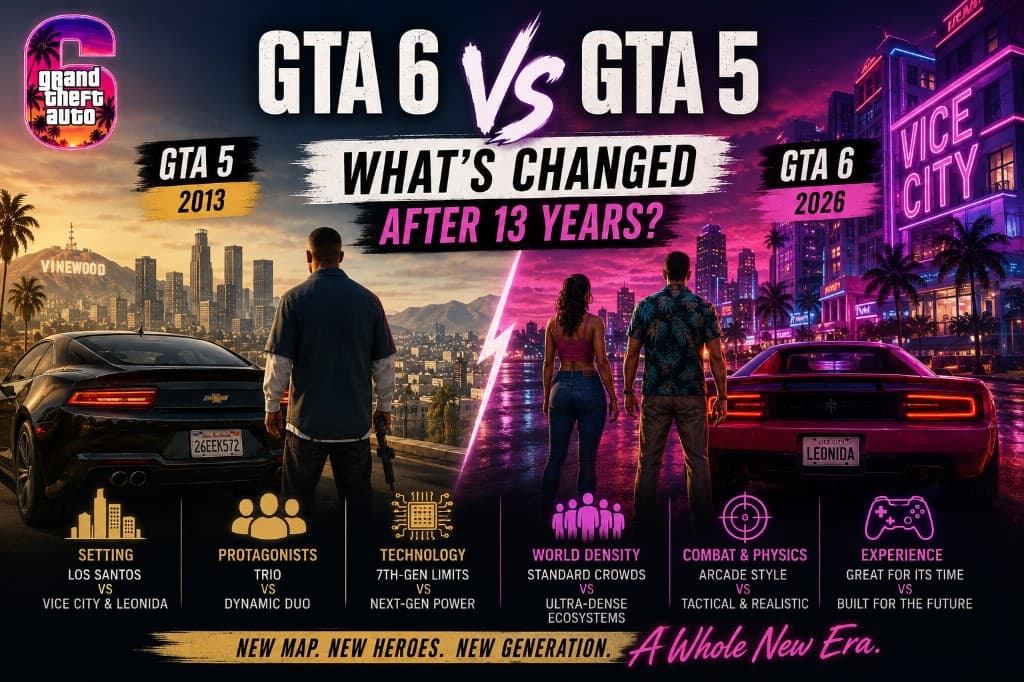
When Grand Theft Auto V launched all the way back in 2013, the Xbox 360 and PlayStation 3 were the reigning hardware standards, smartphones had tiny screens, and gaming looked entirely different. Over a decade later, the gaming landscape has shifted dramatically.
With Grand Theft Auto VI set to launch on November 19, 2026, for current-generation consoles, the gap between the two titles spans more than 13 years. That isn't just a generational gap — it represents an entirely different era of game development.
Here is how Rockstar Games has evolved the franchise from Los Santos to the neon-soaked state of Leonida.
Focus: GTA 6 vs GTA 5 — setting, protagonists, tech, world density, combat, and a side-by-side summary of what 13 years changed.
The Setting: Return to Vice City and Leonida
Rockstar Games is trading the sun-bleached asphalt and desert expanses of Los Santos for a modernized, sun-soaked playground. Leonida captures the vibrant, diverse ecology of Florida, spanning neon-drenched urban skylines, sprawling wetlands, and coastal keys. This new map blends old-school nostalgia with modern open-world scale, offering an entirely different atmosphere defined by humidity, bright neon, and chaotic coastal energy.
GTA 5
Centred around Los Santos and Blaine County, the fifth installment delivered a satirical, sprawling snapshot of Southern California. Its map paired an expansive urban core with quiet desert highways and rugged mountains. While groundbreaking for its time, its open-world design was ultimately constrained by seventh-generation hardware limits, prioritizing classic sandbox freedom over dense architectural interiors.
GTA 6
Leonida redefines environmental storytelling through unprecedented world density and fidelity. Every neighborhood, from bustling city streets to remote marshes, feels alive with reactive wildlife, hyper-detailed infrastructure, and massive crowds. Vice City evolves from a retro playground into a living, breathing metropolis built specifically to harness current-generation hardware capabilities.
Protagonists: From a Trio to a Dynamic Duo
Character dynamics have undergone a massive conceptual shift, trading sprawling multi-perspectives for an intimate, highly focused criminal partnership. This evolution changes how the narrative unfolds, emphasizing emotional tension and collaborative heists over segmented individual storylines. By focusing on a pair deeply entangled in both romance and crime, the story captures a gritty, modern Bonnie and Clyde aesthetic.
GTA 5
Michael, Franklin, and Trevor broke new ground by allowing players to switch seamlessly between three distinct lives across Los Santos. This trio offered wildly different perspectives, from a retired suburban heist artist to a volatile street hustler and an unhinged sociopath, injecting unpredictable variety directly into the core campaign.
GTA 6
Jason and Lucia mark a historic franchise milestone as its first-ever dual protagonists featuring a playable female lead. Their intertwined criminal journey centers on survival, loyalty, and high-stakes lawbreaking, creating a deeply personal narrative bond that drives the entire Leonida underworld adventure forward.
The Technical Leap: Built for SSDs and Ray Tracing
The hardware evolution over the last decade represents a generational quantum leap. Transitioning from mechanical hard drives to ultra-fast solid-state storage eliminates traditional streaming bottlenecks and asset pop-in entirely. Combined with advanced ray-traced global illumination, materials, wet surfaces, and lighting react with physical authenticity, transforming static game worlds into dynamic, photorealistic digital environments that truly push ninth-generation console hardware to its absolute limits.
GTA 5
Developed primarily for seventh-generation consoles with mechanical hard drives, the title relied heavily on clever resource management and asset streaming tricks. While impressive for 2013 hardware, its rendering pipeline lacked modern global illumination, sophisticated material shaders, and seamless spatial streaming, resulting in visible texture pop-in and rigid lighting models across its massive open world.
GTA 6
Engineered specifically for current-generation systems, the game utilizes a modern physically-based rendering pipeline and real-time ray tracing. This unlocks stunning lighting accuracy, hyper-realistic reflections on vehicle paint, and intricate weather physics, ensuring Leonida looks and feels like a living, breathing next-generation reality.
World Density and AI Simulation
Artificial intelligence and population density define the realism of modern gaming worlds. Moving far beyond scripted routines, contemporary game engines simulate complex, organic ecosystems where crowds react intelligently to the environment. From bustling city blocks to secluded beaches, every pedestrian exhibits distinct behaviors, dynamic pathfinding, and realistic psychological responses, making the game world feel genuinely alive, unpredictable, and entirely reactive to player actions.
GTA 5
Non-playable characters operated on basic, early-2010s pathfinding algorithms. While streets felt reasonably populated, crowds were largely static, recycling predictable animation loops and standard panic routines when startled, which frequently exposed the structural limitations of seventh-generation open-world simulation capabilities.
GTA 6
Crowd density scales up exponentially, featuring hundreds of fully simulated pedestrians with advanced strand-based hair, unique clothing physics, and deeply contextual daily routines. NPCs react naturally to weather changes, traffic incidents, and player aggression, creating an immersive, living social fabric across Leonida.
Combat, Movement, and Physics
Core gameplay mechanics have evolved from arcade accessibility into deeply tactile experiences. Movement fluidity, tactical cover systems, and weapon handling now prioritize realistic weight and momentum. Physics engines simulate physical impact, material deformation, and environmental interaction with staggering precision. Every gunfight, foot chase, and high-speed collision demands tactical awareness, replacing loose controls with responsive, physics-driven feedback loops that elevate every single player encounter.
GTA 5
Mechanics favored arcade-leaning, pick-up-and-play accessibility. Third-person shooting offered reliable, snappy auto-aim, while vehicle handling prioritized cinematic drifting and forgiving crashes, ensuring seamless navigation across Los Santos without overly punishing players for aggressive driving or chaotic combat choices.
GTA 6
Refines tactical movement through advanced animation blending, natural cover-snapping, and authentic weapon recoil. Vehicles feature complex momentum physics, accurate weight transfer, and hyper-realistic crash deformation, making every high-speed pursuit feel grounded and physically consequential.
Summary Comparison Table
| Feature | Grand Theft Auto V (2013) | Grand Theft Auto VI (2026) | | --- | --- | --- | | Original Hardware | PS3 / Xbox 360 | PS5 / Xbox Series X|S | | Setting | Los Santos & Blaine County | Vice City & Leonida | | Protagonists | Michael, Franklin, Trevor | Jason & Lucia | | Engine Tech | RAGE (7th-Gen Base) | RAGE (Modern PBR & Ray Tracing) | | World Activity | Standard open-world density | Ultra-dense living crowds & ecosystems |
Final Thoughts
The 13-year wait between titles represents the longest gap in Rockstar’s history, but the technological chasm between GTA 5 and GTA 6 justifies the timeline. While GTA 5 set the blueprint for open-world sandboxes of the past decade, GTA 6 is primed to redefine real-time simulation and digital world-building for the current generation.